
50% inventory reduction in less than 6 months

Customer Story
Project Highlights:
- Focus: Material procurement from external suppliers
- Focus on a total of 3 pilot suppliers
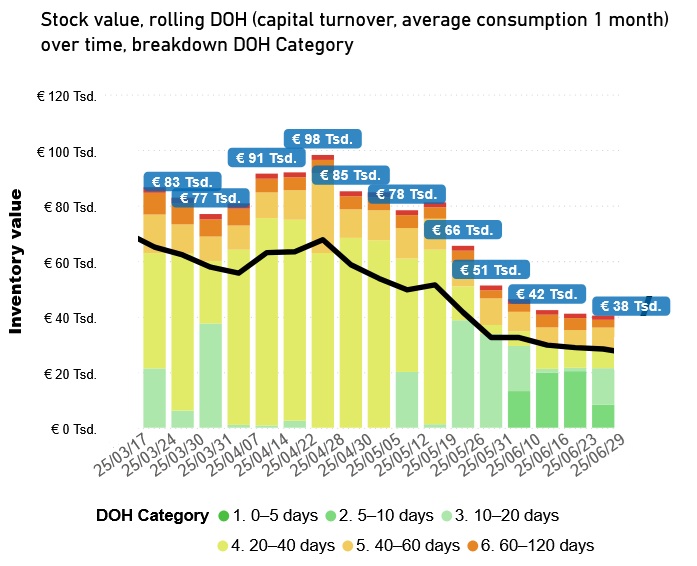
- Inventory reduction: 38–52%
- Timeframe to achieve targets: 5 months
Procurement Logistics in an ERP Environment
For the ongoing procurement of production materials, a company’s ERP system and, in particular, the integrated Material Requirements Planning (MRP) function are primarily responsible. This function typically determines requirements based on individual part numbers and generates proposals for procuring quantities from the respective suppliers.
As a result, each supplier has a portfolio of parts to be procured, which are assigned to different departments within the company for creation and maintenance. These departments often define the key parameters for procurement and demand planning, such as lead times and safety stock levels.
The department responsible for the ongoing procurement of parts (production requirements) no longer processes every individual part manually. Instead, automated processes within the ERP system are often used. As a result, a continuous validation of procurement parameters across the entire supplier portfolio from a supplier perspective does not regularly take place.
This can lead to situations where the same supplier (= procurement source) is assigned different transit times, even though the distance between the source (= supplier) and the consumption or production location (= destination) remains identical.
How the Chaindson Suite supports you
The Chaindson Suite enables exactly this perspective: Starting from the procurement source (either region/country or supplier), it provides a holistic view and comparison of all relevant logistics parameters for the currently assigned parts and materials. This makes deviations in values such as transport times or lead times immediately visible. By gradually aligning these parameters, significant positive effects can be achieved quickly, especially for active and ongoing parts, with regard to inventory levels and inventory coverage.
A key advantage is that the Chaindson Suite combines two essential perspectives: On the one hand, a comprehensive overview of the supplier portfolio, and on the other hand, a detailed view of each individual item. This means that parameter adjustments do not follow a “one-size-fits-all” approach. Instead, individual parts can be excluded where necessary, for example critical safety components that may be subject to specific customer requirements or other limiting factors.
For our customer, an additional factor was the cross-border procurement of parts from one supplier. The ordered goods were collected by the same transport service provider, making the use of different transit and lead times within the ERP system even more questionable. Using the Chaindson Suite, 45 relevant part numbers were identified for this supplier, for which the time-related parameters were to be aligned during the initial pilot phase.
At the start of the project, we selected a representative average inventory value as the benchmark. The parameters were aligned and reduced in three stages. This iterative approach ensured that there were no supply shortages affecting production and no production downtime. This is a crucial aspect of this type of optimization, even though the measures themselves are relatively straightforward to implement.
Throughout this phase, visualizing and monitoring the current inventory coverage of the individual parts was essential, both for evaluating the effectiveness of the measures and for quickly adjusting parameters if inventory coverage approached a critical level.
Focus on Transport
In addition to the capital tied up in high inventory levels and inventory coverage, transport costs account for a significant share of overall logistics costs. It is therefore important to consider not only inventory levels but also the associated transport activities. This is where the Transport Invoice Audit module demonstrates its strengths.
Note on our Customer Stories:
Please understand that we cannot disclose customer names or provide overly detailed information in our Customer Stories. Depending on the initial situation and scope of the project, our clients may be seeking to safeguard or restore their competitiveness or, in some cases, even secure the company’s liquidity. As a trusted partner, we are therefore often entrusted with highly sensitive and confidential information and data.
A strong foundation of mutual trust is essential to the success of such projects. For this reason, we can only provide a general overview of the results achieved for our clients.

Schedule Your Live Demo Now
Our Vice President Lean Research & Digital Development, Michael Spaeth, will be happy to present the tool to you in a live demo. During a joint workshop, we will analyze your individual transport data and identify initial optimization opportunities.
